





President Donald Trump is once again facing intense scrutiny, this time over newly released financial disclosures that reveal an extraordinary volume of stock trading during his first year back in office. While there is currently no official finding that Trump committed insider trading, ethics experts, watchdog organizations, and political opponents argue that the timing of many of the trades warrants closer examination.
More Than 21,000 Stock Trades
According to Trump’s latest financial disclosure, investment accounts connected to his assets executed more than 21,000 securities trades during 2025, representing between $600 million and $1.86 billion in transactions. The sheer number of trades surprised many financial analysts, averaging roughly 85 trades every market day.
The Trump Organization maintains that these investments are handled independently by outside financial institutions using automated portfolio strategies. The White House has likewise stated that Trump does not direct the trades and receives no advance notice of investment decisions.
The Tariff Timing That Sparked Questions
The controversy centers on several periods where trading activity coincided with major policy announcements capable of moving financial markets.
One of the most discussed examples occurred in April 2025. Financial disclosures show that Trump’s investment accounts purchased millions of dollars worth of shares in companies such as Apple, Microsoft, Nvidia, and Berkshire Hathaway shortly before the administration announced a pause to sweeping tariffs. Markets surged following the announcement, producing one of the strongest single-day rallies in years.
Critics argue that purchasing stocks immediately before market-moving government announcements creates at least the appearance of a conflict of interest, even if no laws were broken.
Additional Trades Under the Microscope
Analysts have identified several other transactions that are receiving attention:
- Large purchases of technology companies before major AI-related government announcements.
- Investments in companies that later received favorable federal actions or government partnerships.
- Significant activity involving defense and semiconductor firms around major policy decisions.
None of these trades, by themselves, prove insider trading. However, ethics specialists say they illustrate why presidents typically place assets into genuinely blind arrangements that eliminate even the appearance of benefiting from official decisions.
Is There Evidence of Insider Trading?
At this stage, there has been no formal accusation or criminal charge alleging insider trading against Donald Trump related to these disclosures.
Instead, the debate focuses on whether the combination of presidential authority, market-moving announcements, and extensive personal investment activity creates unacceptable ethical risks.
Insider trading generally requires proof that someone traded securities while possessing material, non-public information in violation of securities laws. Publicly available information has not established that legal threshold.
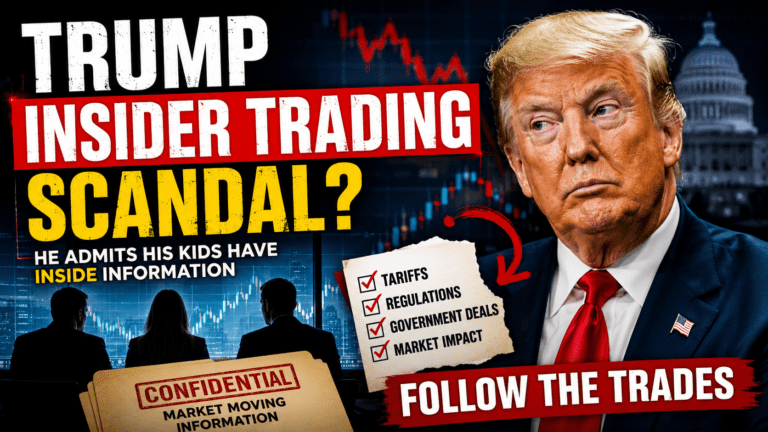
During a CNBC interview, Trump said his children “have inside information” because of his position as president. Critics argue the statement amounts to an extraordinary admission that the president’s family possesses market-moving nonpublic information. Trump, however, maintained that he does not manage his investments and that his children avoid conflicts where possible. No evidence has yet been made public showing that his children used such information to execute illegal stock trades
Trump’s Response
Trump has dismissed the criticism, arguing that he does not personally manage the investments.
Speaking to reporters, he said that outside institutions control the accounts and attributed the gains to the broader strength of the stock market rather than any presidential actions. The Trump Organization has similarly stated that investment decisions are made independently through third-party managers.
Ethics Experts Remain Concerned
Government ethics advocates argue that even if every trade complied with securities laws, the disclosures highlight broader concerns about conflicts of interest.
Presidents possess unique authority to influence markets through tariffs, executive orders, regulatory decisions, government contracts, and public statements. When large personal investment portfolios continue trading during a presidency, critics say public confidence can suffer if investors believe officials may personally benefit from policy decisions.
Supporters counter that independently managed portfolios are common and that no evidence has emerged showing Trump personally directed any of the trades.
The Bottom Line
The latest disclosures have fueled another political and ethical debate surrounding Donald Trump’s finances. While critics argue the timing of certain investments deserves further investigation, there is currently no official finding or criminal allegation that Trump engaged in insider trading.
Whether the controversy results in congressional investigations, additional ethics reviews, or simply remains a political flashpoint will likely depend on what further evidence, if any, emerges in the months ahead.