




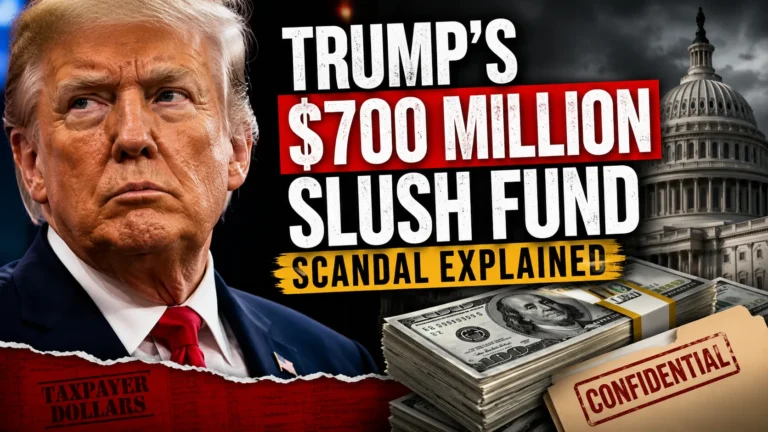

The Trump administration is facing intense scrutiny over what critics have labeled a "$1.8 billion slush fund," a controversial Department of Justice settlement that has sparked legal challenges, bipartisan criticism, and accusations of executive overreach.
While supporters argue the fund was designed to compensate Americans who were unfairly targeted by politically motivated government investigations, opponents say it represents one of the most troubling conflicts of interest of Donald Trump's second presidency.
What Is the Controversy?
The dispute centers on a settlement between President Donald Trump and the U.S. Department of Justice following Trump's $10 billion lawsuit against the Internal Revenue Service over the illegal leak of his tax returns.
Under the settlement, the government agreed to establish a $1.776 billion "Anti-Weaponization Fund." According to the administration, the money would compensate individuals who could demonstrate they were victims of politically motivated government investigations or prosecutions.
Critics immediately dubbed the proposal a "slush fund," arguing that the president would have enormous influence over how taxpayer money could ultimately be distributed.
Why Critics Are Alarmed
Legal scholars, ethics watchdogs, and many Democratic lawmakers argue the fund raises serious constitutional and ethical concerns.
Among the primary criticisms are:
- The fund was created without a direct congressional appropriation.
- Eligibility criteria were initially broad and lacked transparency.
- Trump allies, including individuals connected to January 6 prosecutions, were widely expected to seek compensation.
- The settlement also reportedly included provisions affecting IRS oversight related to Trump and affiliated entities, raising additional conflict-of-interest concerns.
Former Justice Department officials described the arrangement as an unprecedented use of executive authority, while several legal experts argued it blurred the line between presidential power and personal political interests.
Republicans Also Expressed Concern
Unlike many previous controversies surrounding Trump, opposition did not come solely from Democrats.
Several Republican lawmakers questioned both the legality and appearance of the arrangement, expressing concern that the executive branch appeared to be creating a large compensation fund with insufficient oversight.
The bipartisan criticism marked one of the few occasions during Trump's second term where members of his own party publicly pushed back against a major administration initiative.
Federal Courts Step In
The controversy quickly moved into the courts.
In June 2026, U.S. District Judge Leonie Brinkema issued a preliminary injunction blocking the administration from moving forward with the fund while litigation continues.
The judge criticized the government's failure to formally terminate the program despite public statements suggesting it would not proceed, noting that informal assurances were insufficient.
As of early July 2026, the fund remains effectively frozen while legal challenges continue.
The White House's Position
The Trump administration has defended the proposal, arguing it was intended to compensate Americans harmed by what Trump has repeatedly described as the "weaponization" of federal law enforcement.
Administration officials maintain that the settlement was legally negotiated and that the compensation program would provide relief for individuals who suffered political persecution.
Supporters also point to the acknowledged illegal disclosure of Trump's tax records as evidence that genuine government misconduct occurred.
Why It Matters
The controversy extends beyond the fund itself.
Legal experts argue the case could establish important precedents regarding presidential authority, the limits of Justice Department independence, and whether the executive branch can create large compensation mechanisms without explicit congressional approval.
The outcome may also shape future debates over government accountability, executive power, and conflicts of interest involving sitting presidents.
Regardless of one's political perspective, the dispute has become one of the defining legal and constitutional battles of Trump's second administration, with courts now tasked with determining whether the fund represents a lawful exercise of executive authority or an unprecedented misuse of government power.