




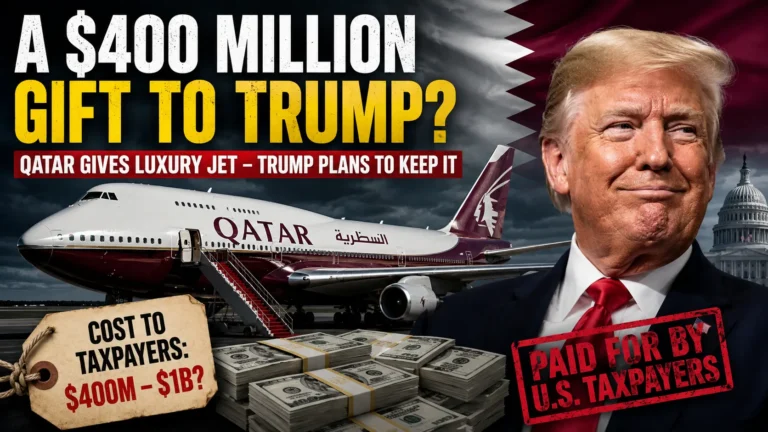

President Donald Trump is once again at the center of controversy, this time over a luxury Boeing 747-8 gifted by the government of Qatar. While the aircraft itself carries an estimated value of $400 million, critics argue the real price tag will ultimately be paid by American taxpayers.
A Gift Worth $400 Million
The Boeing 747-8, often described as a "palace in the sky," was provided by Qatar as an interim replacement for the aging Air Force One fleet while Boeing continues to delay delivery of the next generation presidential aircraft.
Trump has praised the jet, calling it one of the finest aircraft ever built and arguing that accepting the gift saves the United States money compared to purchasing an entirely new aircraft.
However, the plane is far from "free."
The Hidden Cost
Before any aircraft can serve as Air Force One, it must undergo extensive modifications. These include:
- Highly secure communications systems
- Missile defense countermeasures
- Electromagnetic pulse (EMP) hardening
- Classified intelligence and command equipment
- Military-grade encryption
- Presidential security upgrades
Initial Pentagon estimates placed retrofit costs at under $400 million, but several lawmakers, defense analysts, and media reports have warned the final cost could approach $1 billion, depending on the classified systems ultimately installed.
Those expenses are funded by U.S. taxpayers, not Qatar.
Trump Plans to Keep the Aircraft
Perhaps the most controversial aspect of the arrangement is what happens after Trump's presidency.
According to multiple reports, the aircraft is expected to be transferred to the Donald J. Trump Presidential Library Foundation once it is no longer needed for presidential service. Supporters argue the transfer follows existing legal procedures because the aircraft was officially donated to the Department of Defense rather than directly to Trump.
Critics counter that a $400 million foreign gift eventually ending up associated with a former president creates significant ethical concerns and raises questions under the Constitution's Foreign Emoluments Clause, even if administration lawyers maintain the arrangement is lawful.
Bipartisan Concerns
Opposition to the deal has not been limited to Democrats.
Several Republican lawmakers and conservative commentators have questioned whether accepting such a valuable gift from a foreign government aligns with the "America First" message that has defined much of Trump's political career.
National security experts have also warned that thoroughly inspecting and modifying a foreign-owned aircraft presents unique intelligence and security challenges before it can safely transport the President of the United States.
Is It Really Saving Money?
The White House argues that using Qatar's aircraft avoids years of additional delays while Boeing continues work on the official replacement Air Force One fleet.
Critics respond that once retrofit costs, long-term maintenance, inspections, security upgrades, and operational expenses are considered, taxpayers may still spend hundreds of millions of dollars on an aircraft that will only serve temporarily before being transferred out of government service.
Whether the aircraft ultimately costs taxpayers $400 million or approaches $1 billion, one point remains clear: while the jet itself may have been gifted, preparing it for presidential duty is anything but free.
The Political Debate Continues
The Qatar aircraft has become another flashpoint in the debate surrounding ethics, government spending, and presidential accountability.
Supporters see the arrangement as a practical solution to Boeing's years-long delays and an opportunity to modernize the presidential fleet more quickly.
Opponents see it as an unprecedented foreign gift that could saddle taxpayers with enormous costs while eventually benefiting Trump's presidential legacy through its planned transfer to his presidential library.
As Congress continues seeking more transparency about the project's true cost, taxpayers may ultimately learn that the most expensive part of this "gift" was never the airplane itself, but everything required to make it fly as Air Force One.