


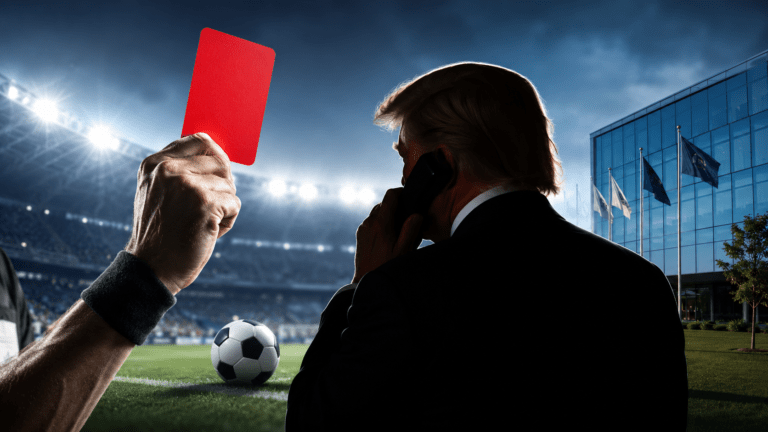

The 2026 FIFA World Cup has delivered no shortage of memorable moments, but few have generated as much controversy as FIFA’s decision to suspend the automatic ban handed to United States striker Folarin Balogun. What transformed an already heated football debate into a global political story was one unexpected detail: U.S. President Donald Trump personally contacted FIFA President Gianni Infantino and asked for the decision to be reviewed.
The result has left football fans, players, and officials asking an uncomfortable question: Where should the line be drawn between politics and sport?
A Controversial Red Card
Balogun was sent off during the United States’ World Cup victory over Bosnia and Herzegovina after a VAR review determined that he had seriously fouled defender Tarik Muharemović. The straight red card carried an automatic one-match suspension, meaning the U.S. appeared set to lose its leading scorer ahead of a crucial Round of 16 clash with Belgium.
U.S. manager Mauricio Pochettino immediately argued that the challenge did not warrant a red card, describing it as an accidental collision rather than serious foul play. Many American supporters agreed, while others believed the referee had simply enforced the Laws of the Game.
Trump’s Intervention
According to Reuters and multiple other news organizations, President Donald Trump contacted FIFA President Gianni Infantino earlier in the week and requested that FIFA review Balogun’s suspension. The call reportedly came before FIFA announced its decision to suspend the one-match ban.
Following FIFA’s announcement, Trump celebrated the outcome on Truth Social, thanking FIFA for correcting what he described as a “great injustice.” The White House has also been reported to have supported efforts surrounding the review process.
FIFA’s Unusual Decision
Importantly, FIFA did not erase the red card itself.
Instead, football’s governing body invoked Article 27 of its disciplinary code to suspend the automatic one-match ban for a one-year probationary period. If Balogun commits another similar offence during that period, the suspension can be reinstated.
While Article 27 exists within FIFA’s regulations, its use in this situation is considered highly unusual, particularly during a World Cup knockout stage. The decision immediately raised questions about consistency and whether similar treatment would be available to players from other nations.
Belgium Reacts
The loudest criticism has come from Belgium, the United States’ Round of 16 opponent.
Belgian football officials expressed frustration over the timing and fairness of the decision, with reports indicating they are examining possible legal options. Belgium’s coaching staff also questioned why a suspension that appeared automatic under tournament rules was suddenly set aside.
For Belgium, the issue extends beyond one player. It touches on competitive integrity and whether every team is truly operating under the same rules.
Politics Meets Football
Football has often intersected with politics, but direct intervention in disciplinary matters by a sitting head of state is extraordinarily rare.
Supporters of Trump’s involvement argue that leaders should advocate for their national teams whenever they believe an injustice has occurred.
Critics counter that disciplinary decisions must remain independent of political influence. Even if FIFA ultimately made the decision itself, the perception that political pressure may have influenced the outcome could damage confidence in the governing body’s neutrality.
In elite sport, perception can be almost as important as reality.
What Happens Next?
Balogun is now eligible to face Belgium, giving the United States a significant boost heading into one of its biggest matches of the tournament.
Whether FIFA’s decision proves to be a one-off application of its disciplinary code or establishes a precedent for future cases remains to be seen. What is already clear is that this controversy will be remembered long after the final whistle.
The World Cup is supposed to be decided by the players on the pitch. This episode has reminded everyone that events off the field can sometimes dominate the headlines just as much as the football itself.