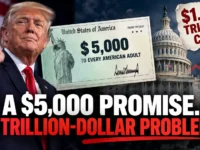






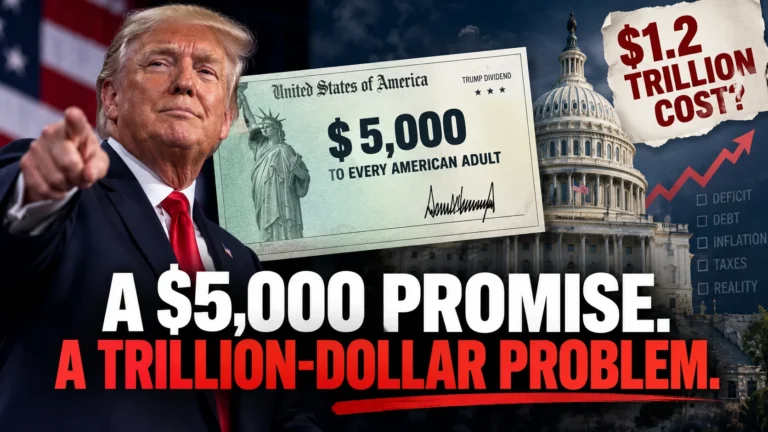

Donald Trump has promised a $5,000 “Trump Dividend” to every adult American citizen if Republicans win the 2026 midterms. But with a potential price tag exceeding $1.2 trillion, the numbers raise serious questions about whether the promise could ever realistically be delivered.
Donald Trump has made one of the most extraordinary promises of the 2026 midterm election campaign: if Republicans retain control of both the House of Representatives and the Senate, every adult American citizen will receive a $5,000 payment.
Speaking at the Republican midterm convention in Dallas on September 9, Trump called the proposed payment the “Trump Dividend.”
His message was remarkably straightforward:
“If the Republicans win, you win with us and you get $5,000.”
Trump also said he would issue the payment to “every adult citizen in the United States of America.”
For millions of Americans struggling with food prices, housing costs, insurance premiums and other expenses, $5,000 understandably sounds attractive.
There is just one rather enormous problem.
The arithmetic.
Around 245 Million Americans Could Qualify
CBS News, citing Census Bureau figures, estimates that approximately 245 million U.S. citizens are aged 18 or older.
The calculation therefore becomes painfully simple:
245 million adults × $5,000 = $1.225 trillion
That is roughly $1.2 trillion for a single round of payments.
Other independent estimates arrive at essentially the same number. The nonpartisan Committee for a Responsible Federal Budget estimates the proposal would cost about $1.2 trillion in one year.
Reuters has placed the potential cost even higher, at around $1.35 trillion, depending on exactly who qualifies.
Whichever estimate you use, we are talking about considerably more than one trillion dollars.
That is not loose change hiding between the cushions of the federal budget.
Put $1.2 Trillion Into Perspective
The Congressional Budget Office currently projects that the entire federal government will collect approximately $5.6 trillion in revenue during fiscal year 2026, while spending around $7.4 trillion.
A $1.225 trillion Trump Dividend would therefore equal roughly:
- 22 percent of all annual federal revenue
- 16.5 percent of total federal spending
- roughly two-thirds of the currently projected $1.9 trillion annual deficit
And remember: this would be a new expense on top of existing government spending.
The Committee for a Responsible Federal Budget estimates that issuing the payments in 2027 could push the projected federal deficit to approximately $3.1 trillion.
That is where the promise begins colliding rather violently with reality.
It Would Cost More Than Some of America’s Biggest Programs
According to calculations reviewed by PolitiFact, a $1.2 trillion payout would exceed annual federal spending on several enormous government programs.
The estimated price would be greater than annual spending on Medicare, national defense or interest on the national debt individually.
That gives some perspective to the scale involved.
This is not another modest rebate program.
It would be one of the largest direct cash distributions in American history.
Can Tariffs Pay for It?
One possible explanation offered by Trump and members of his administration is that tariff revenue could help finance the dividend.
But the numbers do not come close.
The Committee for a Responsible Federal Budget estimates that current tariffs are generating less than $200 billion per year.
Even generously assuming $200 billion in tariff revenue, you would still face a gap of roughly:
$1.2 trillion − $200 billion = $1 trillion
And there is another problem.
That tariff revenue is already included in federal budget projections. It is not a separate trillion-dollar piggy bank sitting untouched in Washington.
Using it for dividend payments would therefore require replacing revenue elsewhere or increasing borrowing.
There is also an inconvenient economic reality surrounding tariffs: tariffs are taxes on imported goods. While foreign companies can absorb some of their cost, much of the financial burden can ultimately be passed through American businesses and consumers in the form of higher prices.
Calling tariff revenue “free money” does not make it free.
The Government Is Already Running Huge Deficits
The United States is hardly entering this debate with a giant budget surplus.
The Congressional Budget Office projects a federal deficit of approximately $1.9 trillion in 2026. Federal debt held by the public is projected at around 101 percent of GDP.
More recent CBO estimates suggest the federal government had already borrowed roughly $2 trillion during the first eleven months of fiscal year 2026.
Adding another $1.2 trillion in spending without matching cuts or new taxes would therefore mean considerably more borrowing.
And borrowing is not magical money either.
Eventually it means additional interest payments, which themselves become part of future federal budgets.
Could Congress Technically Do It?
Yes.
This is an important distinction.
The $5,000 promise is not mathematically impossible.
Congress has the authority to approve enormous spending programs. The federal government could borrow the money, increase taxes, cut other programs or create some combination of all three.
But Trump cannot simply announce a $1.2 trillion payment and send the checks himself.
A program of this magnitude would almost certainly require congressional authorization and funding. That remains one of the major unanswered questions surrounding the proposal.
Trump has so far provided few concrete details explaining precisely how the dividend would be funded, who would qualify beyond being an adult citizen, or how Congress would authorize it.
That makes this less of a financial plan and more of an extremely expensive campaign promise.
What If Wealthier Americans Are Excluded?
Vice President JD Vance has suggested that wealthy Americans might eventually be excluded from the program.
That would obviously reduce the cost.
But it would also contradict the original promise of a $5,000 dividend for every adult citizen.
And even a heavily means-tested version would still cost hundreds of billions of dollars unless eligibility were dramatically restricted.
There is an enormous difference between saying:
“Every American adult gets $5,000.”
and later saying:
“Some Americans might get some version of it depending on income and congressional negotiations.”
The first is a campaign slogan.
The second is how government spending actually works.
Then There Is Inflation
Dumping more than a trillion dollars into an economy already experiencing inflationary pressure could create another problem.
Demand.
Give hundreds of millions of people thousands of dollars simultaneously and consumer spending is likely to rise sharply.
If the supply of goods and services does not rise alongside that demand, prices can increase.
The Committee for a Responsible Federal Budget argues that the proposal would likely increase inflation and interest rates because the economy is already operating near its potential.
Economist Marc Goldwein has estimated that the additional spending could potentially add around 1.5 percentage points to inflation, although estimates of inflationary effects depend heavily on how the program is financed and how quickly households spend the money.
That creates a strange contradiction.
A payment supposedly designed to make life more affordable could potentially contribute to making goods and borrowing more expensive.
A $5,000 Check Is Much Easier to Promise Than to Finance
There is no mystery behind why a politician might promise voters $5,000.
It sounds fantastic.
For a married couple, that potentially means $10,000.
For households struggling with bills, debt, rent or groceries, that is serious money.
But national budgets do not operate on campaign applause.
If approximately 245 million people receive $5,000 each, somebody ultimately has to provide approximately $1.225 trillion.
The federal government has only a few ways of doing that:
raise revenue, cut spending elsewhere, borrow the money or combine all three.
There is no fourth option where the trillion dollars simply materializes.
The Bigger Political Question
Perhaps the most unusual part of Trump’s announcement is that the payment was explicitly linked to the result of the midterm elections.
Trump did not simply propose sending Americans $5,000.
He promised the payment if Republicans retain the House and Senate.
That framing has understandably generated controversy.
Legally, election experts cited by the Associated Press have noted that the proposal is not necessarily voter bribery because Trump is not literally offering individuals money in exchange for proof that they personally voted Republican.
Politically, however, the message could hardly be clearer:
Elect Republicans and Americans get $5,000.
Trump himself appeared to acknowledge the electoral appeal when he joked that the promise alone should be enough to win the midterms.
The Bottom Line
Trump’s $5,000 dividend is theoretically possible.
Almost anything is theoretically possible if Congress is willing to authorize enough borrowing.
But based on the promise as Trump originally presented it, the numbers are staggering.
Around 245 million eligible adult citizens.
Approximately $1.2 trillion to $1.35 trillion in total payments.
Less than $200 billion annually in new tariff revenue cited as a possible funding source.
And a federal government already running a deficit approaching $2 trillion per year.
The mathematics do not show that sending the checks is literally impossible.
They show something arguably more important:
There is currently no credible explanation for how the United States could pay for Trump’s $5,000-per-adult promise without enormous additional borrowing, major spending cuts or significant new revenue.
Until such a plan exists, the Trump Dividend should be treated for what it currently is: a campaign promise with a very attractive number attached to it and a roughly $1.2 trillion question mark attached to the bill.