








For generations, children have been asked the same question: What do you want to be when you grow up?
Doctor. Teacher. Firefighter. Engineer. Carpenter. Nurse. Police officer. Scientist.
Today, another answer has become remarkably common: content creator.
YouTube, TikTok, Instagram, Twitch and other platforms have created an entirely new category of celebrity. Someone with a smartphone, an internet connection and the right combination of personality, timing and algorithmic luck can potentially build an audience of millions without ever passing through the traditional gates of television, radio or publishing.
There is nothing inherently wrong with that. Content creation can require creativity, entrepreneurship, editing skills, marketing knowledge and a tremendous amount of work.
But it has also created a strange economic and cultural contradiction.
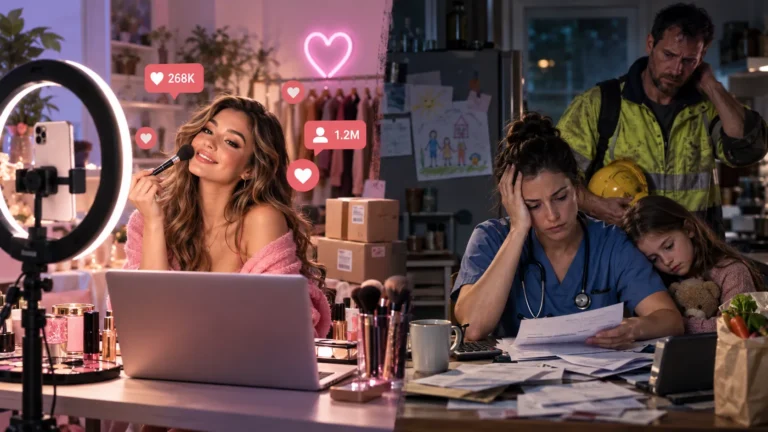
A nurse can work a demanding shift caring for sick patients. A construction worker can spend an entire day building homes. A teacher can educate thirty children. A retail employee can spend eight hours on their feet dealing with customers.
Meanwhile, a successful creator can film themselves trying a new lipstick, reviewing a restaurant or reacting to somebody else’s video and potentially earn far more.
When society financially rewards attention more aggressively than it rewards many forms of essential work, it is reasonable to ask what message we are sending to the next generation.
Young People Really Do Want to Become Creators, But the Picture Is More Complicated
The idea that large numbers of young people dream about becoming influencers isn’t imaginary.
Pacsun’s 2025 Youth Report, produced with GlobalData and based on more than 6,000 Americans aged 11 to 24, found that approximately 22% either wanted to pursue or were pursuing a career as a content creator or influencer. Among Gen Alpha respondents, the figure reached 28%.
That is an extraordinary percentage for a career that barely existed in its current form twenty years ago.
However, claims that this number is simply increasing every year need qualification.
The same survey conducted in 2026 found interest in influencer and creator careers falling to approximately 18.8%, while medical and healthcare careers narrowly moved ahead at 19%. The 2026 survey included 6,126 Americans aged 11 to 24. It also found that 62% considered having a stable job one of their major goals by age 35.
Another major survey points in the same direction. Pew Research Center reported in 2025 that 86% of American teenagers considered having a job or career they enjoy extremely or very important, while only 6% said becoming famous was highly important to them.
So this is not evidence of an entire generation deciding that work is beneath them.
The more interesting problem is subtler.
Young people are growing up inside an economy where they can see, every day, examples of individuals apparently earning enormous amounts of money doing something that looks considerably easier and more glamorous than conventional employment.
And they rarely see the thousands who tried the same thing and earned almost nothing.
The Creator Economy Has a Huge Winner Problem
Social media makes successful creators incredibly visible.
Unsuccessful creators are almost invisible.
That creates a distorted picture of what the profession actually looks like.
Goldman Sachs estimated that there were around 50 million creators globally, with the creator economy potentially approaching half a trillion dollars in value by 2027.
That sounds like an enormous opportunity.
But Goldman Sachs also estimated that only around 4% of creators qualify as professionals earning more than $100,000 per year. Brand partnerships account for roughly 70% of creator revenue.
Academic research suggests that earnings are extraordinarily unequal.
A 2026 study examining YouTube creators in Germany, Austria and Switzerland calculated a Gini coefficient of 0.89 for creator earnings, indicating extreme income inequality within the platform economy.
In other words, seeing successful influencers online is a little like watching professional football and concluding that playing football is an easy road to wealth.
You are mostly seeing the winners.
When Reviewing Makeup Can Pay More Than Building the World Around Us
Here is where the cultural contradiction becomes uncomfortable.
According to the U.S. Bureau of Labor Statistics, the median full-time American worker earned $1,204 per week in 2025. Workers aged 16 to 24 earned considerably less, with median weekly earnings of $805 for young men and $725 for young women.
Many jobs that society depends upon pay even less. In May 2025, for example, the median annual wage for retail sales workers was approximately $36,320.
Successful influencers can exceed those amounts dramatically through sponsorships, advertising, affiliate commissions, subscriptions and merchandise.
There is nothing inherently immoral about that. Entertainment has always produced enormous financial rewards for a relatively small number of people.
The difference today is accessibility.
Movie stars used to appear on distant cinema screens. Influencers appear in your bedroom every night.
They talk directly into the camera. They film themselves eating breakfast. They answer comments. They show their homes. They tell viewers what they bought.
The lifestyle therefore feels attainable.
A teenager watching someone earn thousands of dollars promoting cosmetics may reasonably wonder why they should spend years studying to enter a difficult profession that offers less money, longer hours and considerably more responsibility.
That is not laziness.
It is an economic incentive.
And perhaps society should be asking why so many jobs that we describe as “essential” are compensated in ways that often make them financially less attractive than capturing attention online.
The Danger Is Not That Content Creation Isn’t Work
It would be unfair to pretend successful creators simply sit on a sofa and occasionally press “record.”
Many operate effectively as small businesses.
They negotiate contracts, edit videos, manage advertising, analyze statistics, communicate with audiences, maintain websites, pay contractors and constantly produce new material.
Burnout among creators is real, and income can disappear almost overnight if an algorithm changes, an account is suspended or an audience moves elsewhere.
The problem is therefore not that content creation is somehow fake work.
The problem is the perception of effort versus reward.
Social media overwhelmingly displays the rewards.
The holiday.
The expensive car.
The designer clothes.
The beautifully decorated apartment.
The free products.
The sponsorship.
It rarely displays years of failed videos, unstable income, tax bills, cancelled sponsorships or the creator refreshing an analytics page at 2 a.m. wondering why yesterday’s video received 900,000 views and today’s received 7,000.
Young viewers receive a heavily edited version of the economics.
We Are Also Monetizing Appearance
The consequences extend beyond careers.
Influencers don’t merely sell products.
They sell lifestyles.
And increasingly, they sell appearances.
A large body of research has connected exposure to idealized social-media imagery with body dissatisfaction among young people.
A 2026 systematic review examining social media, body image and weight-related behavior among people aged 10 to 24 concluded that idealized standards of thinness and muscularity were associated with body dissatisfaction, restrictive eating, excessive exercise and use of questionable weight-loss products.
Another systematic review examining influencers specifically found that exposure to idealized influencer imagery produced negative effects on body image and mood in several studies, although the researchers also stressed that the overall evidence base has methodological limitations.
A 2025 meta-analysis of experimental research similarly found that exposure to idealized body content reduced body satisfaction among young women, while body-positive material could improve it.
That distinction matters.
Social media itself is not automatically harmful.
What matters enormously is what people repeatedly see.
When teenagers spend hours watching carefully lit, filtered, edited and sometimes digitally altered people presenting themselves as ordinary reality, the boundary between reality and advertising begins to dissolve.
Opinions Can Become Products
There is another issue that traditional media at least attempts to address through editors, fact-checkers and professional standards.
Influencers generally have no such obligation.
Anyone can accumulate millions of followers while having absolutely no professional expertise in the subjects they discuss.
A systematic review published in Social Science & Medicine found several concerns surrounding influencers and adolescent health information, including lack of expertise, commercial interests, unrealistic body imagery and inaccurate diagnosis or treatment advice.
This doesn’t mean influencers are inherently unreliable.
Doctors can be influencers.
Scientists can be influencers.
Journalists, historians, engineers and educators can create excellent online content.
But social-media algorithms generally do not award attention according to qualifications.
They reward engagement.
A confident person saying something outrageous can therefore outperform an expert carefully explaining why reality is complicated.
The algorithm doesn’t necessarily know the difference between credible and clickable.
It knows whether you watched.
Advertising Has Become Harder to Recognize
The business model complicates matters further.
When someone watches a conventional television advertisement, everyone understands what they are seeing.
Influencer marketing deliberately makes that boundary less obvious.
A creator might be talking casually about their skincare routine while simultaneously participating in a commercial relationship worth thousands of dollars.
This is precisely why regulators require disclosure.
The U.S. Federal Trade Commission says influencers must clearly disclose financial or other material relationships with brands and warns that simply assuming followers understand that a recommendation is sponsored isn’t sufficient. The FTC also explicitly states that influencers cannot make claims requiring evidence that an advertiser does not possess.
When advertising looks exactly like friendship, recommendation and everyday life, younger audiences in particular can have difficulty separating authentic opinion from commercial persuasion.
What Happens If Everyone Wants the Spotlight?
There is a tempting dystopian version of this argument: everyone becomes an influencer and eventually nobody is left to build houses, repair electrical systems, teach children, drive trucks or care for patients.
The evidence does not suggest that is happening.
Healthcare remained the most popular career category in the 2026 Pacsun/GlobalData survey, while skilled trades and hands-on work were selected by 13.7% of respondents. Young people continue to value stable employment.
But that doesn’t mean there is nothing worth worrying about.
Societies need people willing to perform difficult, highly skilled and sometimes unpleasant jobs.
If those jobs offer relatively modest financial rewards while social media continuously advertises the possibility of extraordinary wealth through personal branding, society creates a peculiar incentive structure.
The answer should not be to tell young people to abandon their ambitions.
It should be to make reality clearer.
Being a creator can be a legitimate career.
But becoming a wealthy creator is statistically unusual.
Influencers can entertain, educate and contribute meaningfully to society.
But follower counts are not qualifications.
Social media can connect people and provide opportunities that previous generations could hardly imagine.
But an algorithmically perfected lifestyle should not become the measuring stick for a successful human life.
Perhaps We Are Asking the Wrong Question
The debate is often framed as:
Why don’t young people want to work anymore?
The evidence doesn’t really support that sweeping accusation.
A better question might be:
Why have we created an economy where some of society’s most necessary workers can look financially unsuccessful next to someone whose primary economic asset is attention?
Young people are responding to the incentives placed in front of them.
If repairing infrastructure, caring for elderly people, teaching children and performing skilled trades require years of effort while offering limited financial security, we cannot be surprised when a teenager looks at a millionaire YouTuber and thinks:
Why wouldn’t I try that instead?
The creator economy isn’t necessarily the disease.
It may simply be exposing something uncomfortable about the economy surrounding it.
We have become remarkably good at placing a dollar value on attention.
Perhaps the bigger challenge for the next generation is figuring out how to place a fairer value on everything society cannot function without.