






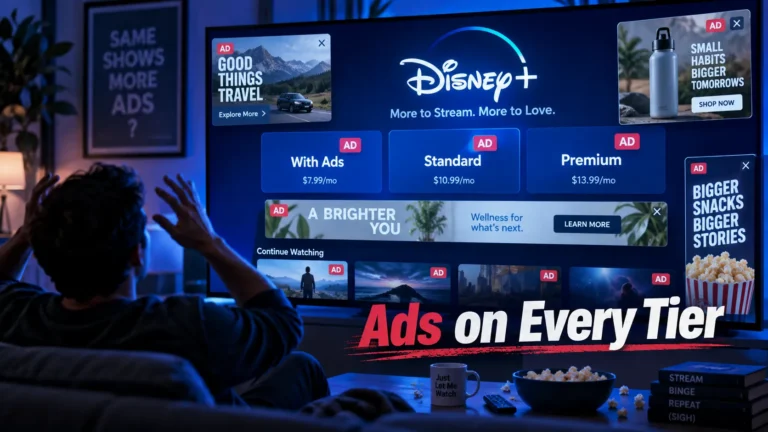

Disney+ subscribers who pay extra to avoid advertising may have noticed something uncomfortable buried in the streaming service’s latest terms and conditions.
Disney has updated its subscriber agreement to make clear that advertising, promotional material and sponsorships can appear across every Disney+ subscription tier, including the more expensive Standard and Premium plans normally marketed around an ad-free viewing experience.
Unsurprisingly, the change has sparked frustration among subscribers, particularly those wondering why they should continue paying a premium price if Disney can still show them advertising.
But there is an important catch to the increasingly dramatic headlines surrounding the story: Disney is not currently saying that Premium subscribers will suddenly have normal commercial breaks inserted into the middle of every movie or episode.
So what exactly has changed?
Even “Ad-Free” Disney+ Can Contain Advertising
Disney+ currently separates its subscriptions into tiers, with cheaper plans supported by advertising and more expensive plans offering movies and series without traditional commercial interruptions.
Disney still describes movies and series on Standard and Premium as being available without advertising. However, the small print now contains a considerably broader definition of what can appear even on those plans.
Disney’s subscription page says that all plans include Disney promotions and sponsorships and may also contain advertisements before or after playback, as well as advertising in channels, live or “as-live” programming, special events and certain third-party on-demand content.
That means “ad-free” no longer necessarily means you will never see an advertisement.
Instead, the distinction appears to be moving toward something closer to “no regular commercial interruptions during most on-demand movies and series.”
That is a much less elegant slogan.
Premium Subscribers Are Asking an Obvious Question
The problem for Disney isn’t simply that an advertisement may appear before a movie.
It is what subscribers believed they were paying for.
Streaming services originally sold themselves as an escape from traditional television. Pay a monthly fee, choose what you want to watch, and enjoy it without sitting through commercial breaks.
Disney itself leaned heavily into consumer choice when it introduced its dedicated ad-supported Disney+ tier in the United States in 2022. Customers who were willing to watch advertisements could pay less, while those wanting an uninterrupted experience could pay more.
That is an extremely easy proposition for consumers to understand:
Pay less, get ads. Pay more, don’t get ads.
Once advertising begins appearing on both sides of that equation, even if it is only before or after a program, the difference becomes considerably murkier.
And subscribers have noticed.
Discussions across social media and online communities quickly filled with criticism after reports about the updated terms began circulating. One large Reddit discussion about the story attracted thousands of votes, while other users questioned why increasingly expensive streaming subscriptions continue adopting characteristics once associated with cable television.
There has also been some pushback against the outrage itself. Disney+ users have pointed out that reports claiming Premium is becoming a fully advertising-supported service exaggerate what Disney actually announced. A highly upvoted post in the Disney+ community specifically challenged claims that traditional ads were suddenly being inserted into all Premium movies and shows.
Both reactions illustrate Disney’s real problem: its definition of “ad-free” is getting increasingly complicated.
Disney Says the Viewing Experience Isn’t Changing
Disney maintains that the updated language largely clarifies rules that already existed and does not represent a sudden transformation of Premium into an advertising-supported subscription.
The company has reportedly said that the viewing experience for Standard and Premium customers remains unchanged. Regular on-demand movies and series on those tiers will continue without traditional commercial breaks appearing throughout the program.
That distinction matters.
Someone watching a two-hour Disney movie on Premium should not interpret the new terms as meaning the film will suddenly stop every ten minutes for commercials.
Instead, the revised language gives Disney significantly more flexibility around promotions, sponsorships and advertisements outside that core viewing experience.
Advertising can potentially appear before or after playback, within live programming, linear channels, special events and third-party content.
Junior profiles remain more restricted regarding commercial advertising.
The Streaming Industry Is Becoming Television Again
The Disney+ controversy is part of a much larger transformation taking place across streaming.
Netflix, Disney+, HBO Max and other services spent years attracting customers with convenient on-demand libraries and relatively simple subscriptions.
The economics changed once streaming became mainstream.
Companies now need to generate substantially more revenue from existing subscribers, and advertising has become one of the industry’s favorite answers.
Disney has been particularly aggressive about expanding its advertising technology. In June 2026, the company detailed new interactive advertising formats being developed for Disney+, including technology designed to make ads more measurable and interactive for advertisers.
The irony is difficult to miss.
Streaming originally disrupted cable television partly because viewers were tired of expensive packages filled with commercials.
Now streaming services are increasingly offering bundles, live television-style channels, sports packages, rising subscription prices and advertising.
The shiny streaming revolution is slowly growing a very familiar moustache.
“Ad-Free” May Need a New Definition
Disney+ isn’t technically eliminating its ad-free subscriptions in the traditional sense.
Standard and Premium subscribers can still watch most regular on-demand movies and television series without commercial breaks interrupting the program.
But the company’s own wording now acknowledges that customers on every plan may encounter promotions, sponsorships and certain forms of advertising.
That leaves Disney with a branding problem.
When somebody pays more specifically because a subscription says “ad-free,” they are unlikely to care about the contractual distinction between an advertisement shown two seconds before a movie starts and one appearing five minutes after it starts.
To the viewer, an ad is an ad.
Disney may therefore be technically correct that the Premium viewing experience has not fundamentally changed while subscribers are equally justified in asking whether the phrase “ad-free” is becoming increasingly meaningless.
And that may be the more important story.
The streaming industry once promised to free viewers from the frustrations of traditional television.
Increasingly, it appears to be rebuilding them one subscription, bundle and advertisement at a time.