


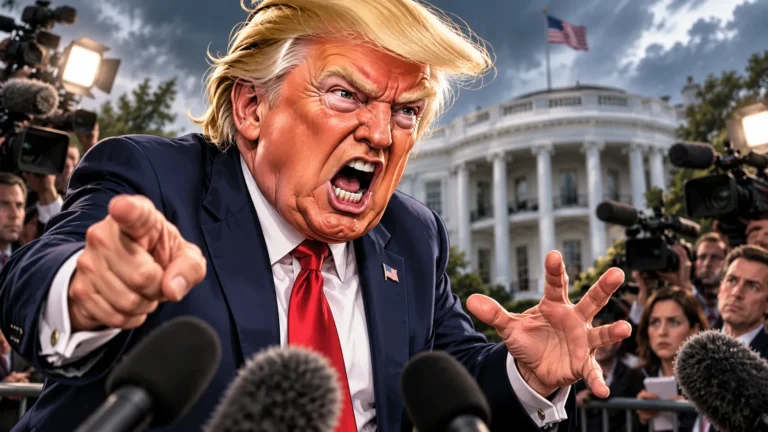

Donald Trump’s long-running feud with mainstream news organizations has escalated from angry posts and accusations of “fake news” into something considerably more consequential: reporters from major media outlets are now being denied access to the White House.
On September 18, 2026, Trump announced that CNN, MS NOW and Politico were being banned from the White House “effective immediately,” accusing the organizations of repeatedly publishing what he called “FICTION and LIES.” He also suggested that other media organizations could face similar treatment.
This was not merely another social-media broadside.
The following morning, journalists working for CNN, MS NOW and Politico attempted to enter the White House and were turned away. Their credentials had been disabled or confiscated, according to reporting from Reuters, CBS News and the Associated Press.
Trump has every right to criticize CNN, Politico, MS NOW or any other news organization. The First Amendment protects the president’s speech too.
The much more complicated question is whether the government can punish news organizations by withdrawing access because the president dislikes what they publish.
And that is where Trump’s latest fight with the press may collide with the First Amendment.
From “Fake News” to Locked Gates
Trump’s hostility toward large traditional media organizations is hardly new.
During his first term, his administration temporarily revoked CNN correspondent Jim Acosta’s White House credential after a contentious press conference. The dispute ended up in federal court, where CNN successfully obtained an order restoring Acosta’s credential.
Trump’s second administration has pushed the issue considerably further.
Rather than merely criticizing individual journalists or refusing to answer particular questions, the White House is now excluding entire news organizations that Trump says have treated him unfairly.
The distinction matters.
A president is not required to grant every journalist an interview. He does not have to answer every question. Space inside the Oval Office is obviously limited, and the White House has legitimate authority to impose security requirements and determine who can physically enter restricted areas.
But once access is routinely granted to members of the press, excluding particular journalists because the government disagrees with their journalism raises a very different constitutional question.
The First Amendment Problem
The First Amendment is only 45 words long, but one section could hardly be more relevant:
Congress may make no law “abridging the freedom of speech, or of the press.”
That does not mean every reporter has an unlimited constitutional right to wander into the White House.
Courts have nevertheless recognized that established White House press-access systems cannot necessarily be administered arbitrarily.
One of the most important cases is Sherrill v. Knight, decided by the U.S. Court of Appeals for the D.C. Circuit in 1977.
The court held that a bona fide Washington journalist’s interest in obtaining a White House press pass implicates First Amendment protections. It also ruled that when a credential is denied, the government must provide appropriate procedural protections, including notice of the reasons for the decision and an opportunity to respond.
In other words, possessing a White House press credential is not an unconditional constitutional entitlement.
But neither is the government automatically free to revoke credentials for whatever reason it chooses.
Trump Has Already Tested This Question
There is an even more relevant example, involving the Trump administration itself.
In 2025, the White House restricted Associated Press access after the AP continued using the name “Gulf of Mexico” in its editorial style rather than exclusively adopting Trump’s preferred “Gulf of America.”
The Associated Press sued.
U.S. District Judge Trevor McFadden initially ruled that the AP was likely to succeed on its First Amendment claims. He wrote that if the government opens particular presidential events to journalists, it cannot exclude a news organization simply because officials dislike that organization’s viewpoint.
However, the legal picture became substantially more complicated on appeal.
A divided D.C. Circuit panel later stayed most of that injunction while the case proceeded. The majority concluded that tightly restricted presidential spaces such as the Oval Office and Air Force One are not traditional First Amendment forums and said the president retains substantial discretion over which journalists receive access to those environments.
That distinction is crucial.
Claims that Trump’s latest ban is obviously and definitively unconstitutional therefore go further than the current case law supports.
But claims that there is no First Amendment issue at all are equally difficult to square with decades of litigation over White House press credentials.
The precise circumstances matter.
Viewpoint Discrimination Could Be the Key
The strongest constitutional argument against the latest bans may be something lawyers call viewpoint discrimination.
The government generally receives much greater constitutional scrutiny when it punishes someone specifically because officials dislike that person’s ideas, opinions or expression.
And Trump has not exactly concealed his stated reason for the bans.
He publicly accused CNN, MS NOW and Politico of producing “fake news,” “fiction” and “lies,” and the affected organizations were subsequently denied entry.
That creates an obvious question for any future court case:
Were these organizations excluded because of neutral security, logistical or credentialing rules?
Or were they excluded because the president disliked their reporting?
The answer could determine whether the bans survive constitutional scrutiny.
This Is Bigger Than CNN
It is tempting to view the controversy through partisan glasses.
People who dislike CNN may shrug.
People who dislike Trump may be outraged.
That misses the more important principle.
Constitutional protections matter most when they protect people and institutions that those in power would rather silence.
A Republican administration excluding CNN because it considers CNN unfair establishes a precedent. The same precedent could theoretically be invoked by a future Democratic administration against Fox News, Newsmax, the New York Post or another conservative organization.
And history provides an instructive example.
The Obama administration was heavily criticized in 2009 after attempting to exclude Fox News from a round of interviews with an administration official. Other major networks reportedly objected to Fox’s exclusion, and the administration ultimately backed down.
The political jerseys can change remarkably quickly.
The constitutional principle does not.
Journalism Does Not Have to Be Nice
News organizations make mistakes.
They publish stories that deserve criticism.
They sometimes display ideological biases.
They can sensationalize events, rely too heavily on anonymous sources, misunderstand complicated subjects or simply get things wrong.
Presidents are perfectly entitled to point those failures out.
Trump can call CNN biased.
CNN can call Trump wrong.
Politico can investigate the administration.
The White House can publicly challenge Politico’s reporting.
That argument is part of a free society.
Using government-controlled access as punishment for unwanted journalism is a much more serious step because the government holds something the journalist does not: state power.
The distinction between criticizing speech and using governmental authority against the speaker is fundamental to the First Amendment.
A Dangerous Incentive
There is also a practical problem.
Imagine the precedent if presidential access becomes dependent on favorable coverage.
Every reporter covering the White House would understand the equation:
Write something the president likes, and the doors stay open.
Write something the president considers unfair, and your credential could disappear.
Even without formal censorship, that creates an incentive for self-censorship.
Independent journalism cannot function properly if access to government officials becomes a reward for agreeable coverage.
The White House press corps exists partly because presidents exercise enormous power and somebody needs to stand in the room and ask uncomfortable questions.
Sometimes those questions will be irritating.
That is not a malfunction of journalism.
It is the point.
The Courts May Have the Final Word
CNN has described the ban as unlawful, while Politico and MS NOW have said they intend to defend their First Amendment rights. Legal challenges therefore appear possible.
If lawsuits follow, courts will have to confront difficult questions involving presidential control over restricted government spaces, existing credentialing procedures, procedural due process and the prohibition against governmental retaliation for protected speech.
The administration can point to recent appellate rulings recognizing broad presidential discretion over access to spaces such as the Oval Office.
The media organizations can point to Sherrill, earlier credential cases and the long-standing constitutional hostility toward government retaliation based on viewpoint.
So the legal answer is not quite as simple as “the First Amendment means every reporter gets into the White House.”
It doesn’t.
But neither can “the president doesn’t like their coverage” automatically settle the matter in the government’s favor.
Free Press Is Supposed to Be Inconvenient
Presidents have complained about journalists for almost as long as the United States has had presidents.
That tension is baked into the system.
A free press does not exist to make presidents comfortable, regardless of whether the president is Donald Trump, Barack Obama, Joe Biden or whoever occupies the Oval Office next.
Trump is free to attack the mainstream media verbally.
He can dispute stories.
He can refuse interviews.
He can publicly accuse journalists of bias.
The First Amendment gives him plenty of room to fight back with words.
But when criticism turns into governmental exclusion specifically because an administration dislikes what journalists are saying, the dispute moves beyond media politics and into constitutional territory.
And that is why the latest White House bans matter even to Americans who have absolutely no affection for CNN, Politico or MS NOW.
The issue is not whether those organizations deserve anyone’s trust.
The issue is whether access to the presidency can become conditional on keeping the president happy.
That is a question much bigger than Donald Trump’s latest fight with the press.