







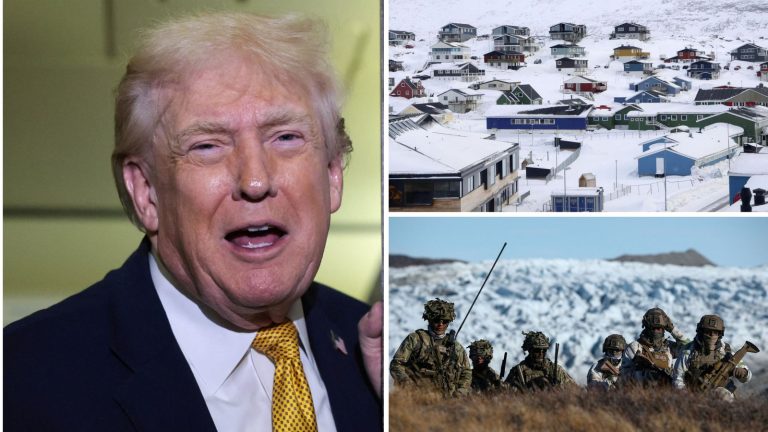

When you think of the United States and Greenland, the mental image that pops up is usually a lone U.S. Air Force plane humming over the icy tundra of Thule, a handful of scientists bundled in parkas, and perhaps a few polar bears wondering why humans keep showing up. Yet beneath that frosty façade lies a bustling geopolitical drama that reads like a modern‑day Arctic thriller—complete with strategic alliances, mineral treasure hunts, climate‑crisis stakes, and a dash of diplomatic intrigue.
Below is a deep‑dive into what’s really happening between the U.S. and Greenland as we stride into 2026, distilled into a readable, slightly witty blog post that you can share with colleagues, friends, or anyone who enjoys a good cold‑front narrative.
1. The Strategic Ice‑breaker: Defense & Security
A. Thule Air Base—America’s Northern Sentinel
Thule Air Base, perched at the top of the world, has long served as the United States’ “lookout tower” over the Arctic. In the past year, Washington and Nuuk (the capital of Greenland) have stepped up joint exercises that focus on:
- Cold‑weather readiness – Think of soldiers learning to march in sub‑zero temperatures without turning into human icicles.
- Missile‑defence radar upgrades – New radar systems now peer farther across the polar sky, spotting potential threats before they become a problem.
Why does this matter? As the Arctic ice recedes, new sea lanes open up, inviting not just commercial ships but also great‑power competition. Russia and China have already signaled interest in the region, so a robust U.S. presence helps keep the Arctic “peaceful” (or at least monitored).
B. Logistics Hub Talk
Washington has floated a modest proposal for a logistics hub adjacent to Thule—a set of upgraded fuel depots, hardened communications gear, and an emergency‑response center. No massive troop surge is on the agenda, but the idea is to guarantee rapid deployment capability should anything go sideways in the far north.
Bottom line: The hub is less about “occupying” Greenland and more about ensuring that if the Arctic becomes a busy highway, the U.S. has a reliable service station.
C. Intelligence & Cyber Cooperation
A 2024 “Strategic Partnership Memorandum” was renewed in early 2026, expanding data‑sharing on satellite surveillance, climate‑impact modeling, and cyber‑security. In plain English: the U.S. and Greenland are swapping weather‑radar pictures and cyber‑threat alerts faster than you can say “polar vortex.”
2. Mining the White Gold: Resources & Green Energy
A. Rare‑Earth Rush at Kvanefjeld
Greenland’s interior houses a trove of rare‑earth elements—neodymium, dysprosium, and the like—that power everything from electric‑vehicle motors to advanced weaponry. The Danish‑Greenlandic government has moved ahead with mining permits for the Kvanefjeld site, and U.S. firms (via the Department of Energy’s Critical Minerals Initiative) are lining up as partners or investors.
Why it matters: Securing a stable supply chain for these metals reduces America’s dependence on China, which currently dominates the global rare‑earth market.
B. Hydropower Dreams & Under‑Sea Cables
A bold, almost sci‑fi‑esque project is under feasibility study: harnessing Greenland’s glacial meltwater for massive hydropower generation and then exporting that clean electricity to Europe via under‑sea cables. If successful, Greenland could become a green‑energy exporter, reshaping European energy politics—and giving the U.S. a strategic foothold in the “green Arctic.”
C. Climate‑Research Collaboration
Beyond the dollars and minerals, there’s a genuine scientific partnership blossoming. Joint U.S.–Greenland research stations are tracking glacial melt, permafrost thaw, and sea‑level rise. Funding from the National Science Foundation has risen by roughly 30 % since 2023, underscoring the importance of Arctic data for global climate policy.
| Factor | Current Status | Relevance to U.S. Relations |
|---|---|---|
| Self‑government | Controls ~75 % of domestic affairs; continues push for greater autonomy. | The U.S. must negotiate directly with Greenlandic authorities, respecting their growing independence. |
| U.S. aid | About $15 million annually for health, education, disaster preparedness. | Soft‑power investment builds goodwill and a constituency supportive of deeper ties. |
| Public sentiment | 2025 poll: 55 % favor stronger U.S. cooperation for economic growth; 30 % fear sovereignty loss. | Any misstep—environmentally or politically—could spark backlash and stall projects. |
4. Hot Spots & Future Forecast
- Russian Naval Activity – Increased Russian patrols near the Arctic Circle have prompted the U.S. to stress “presence” in Greenland. A flare‑up could pull Greenland into larger NATO‑Russia dynamics.
- Mining Controversy – Environmental NGOs (both local and international) criticize the Kvanefjeld project for potential radioactive waste and ecosystem damage. Legal challenges could delay or reshape the venture.
- Energy Export Timeline – The under‑sea cable concept is still in “concept‑validation.” Cost overruns or regulatory snags could push the timeline back, affecting U.S. strategic calculations.
Closing Thoughts – From Ice to Insight
The United States’ relationship with Greenland isn’t just about a cold outpost on a map; it’s a multifaceted partnership that intertwines defense, climate science, resource security, and the aspirations of a people navigating their own path toward autonomy. As the Arctic melts and new opportunities (and challenges) emerge, both sides are learning to balance ambition with responsibility.
Stay warm, stay informed, and keep charting those icy frontiers!
Author’s note: All facts are drawn from publicly available reports (Reuters, The New York Times, Bloomberg, Arctic Institute, and official U.S. & Greenlandic statements) as of January 2026.