







Ever felt your tongue get tangled just thinking about a particularly pretentious piece of prose? You’re not alone. Languages love to stretch themselves, sometimes literally, into sprawling strings of letters that make even the most seasoned logophile pause for breath. In this post we’ll wander through the globe’s most elongated lexemes, uncover the stories behind them, and sprinkle in a dash of humor to keep things lively. Buckle up; it’s going to be a long ride.
1. The Crown Jewel of English
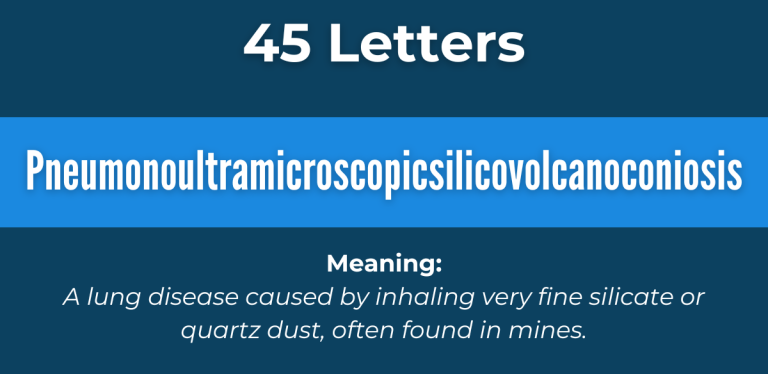
pneumonoultramicroscopicsilicovolcanoconiosis (45 letters)
A lung disease caused by inhaling ultra‑fine volcanic silica dust.
It was coined in 1935 as a deliberate attempt to create the longest English word, and it stuck. While the term itself is medically accurate, its very existence reminds us that sometimes scientists and lexicographers collaborate on a very ambitious crossword clue.
2. The Ancient Greek Gastronomic Marathon
lopadotemachoselachogaleokranioleipsanodrimhypotrimmatosilphioparaomelitokatakechymenokichlepikossyphophattoperisteralektryonoptekephalliokigklopeleiolagoiosiraiobaphētraganopterýgṓn
(182 letters)
Aristophanes invented this absurdly long dish name to poke fun at the extravagant banquets of his day. Imagine trying to order that at a modern restaurant—“I’ll have the… uh… something with a side of bewilderment, please.”
3. Māori Majesty
taumatawhakatangihangakoauauotamateaturipukakapikimaunga
(85 letters)
Translation: “The summit where Tamatea, the man with the big knees, who slid, climbed and swallowed mountains, played his nose flute to his loved one.”
Nestled on New Zealand’s North Island, this place‑name reads like a miniature epic poem. It showcases how indigenous languages can embed entire narratives into a single toponym, talk about efficient storytelling!
4. Technical Tongues:
charged‑particle‑accelerator‑magnet‑coil‑assembly‑maintenance‑procedure
(63 letters)
A mouthful straight out of an engineering manual. While not a dictionary entry, it illustrates how professional jargon can balloon when precision trumps brevity. Engineers love their compound nouns; they’re the Swiss‑army knives of terminology.
5. Germanic Giants
| Word | Length | Meaning |
|---|---|---|
| Rindfleischetikettierungsüberwachungsaufgabenübertragungsgesetz | 63 | “Beef labeling regulation & delegation law” (Bavarian law, repealed 2013) |
| Donaudampfschifffahrts‑elektrizitäten‑hauptbetriebs‑werk‑unterbehälter‑wartungs‑abteilung | 71 | A whimsical compound meaning “Danube steamship electricity main‑operations‑plant sub‑container maintenance department.” |
| Lentokonesuihkuturbiinimoottoriapumekaanikkoaliupseerioppilas (Finnish) | 61 | “Airplane jet turbine engine auxiliary mechanic non‑commissioned officer student.” |
German loves to concatenate nouns, turning a whole sentence into a single word. The result? Lexical fireworks that make English speakers wonder whether they’ve stumbled onto a secret code.
6. Celtic Curiosities
- Llanfairpwllgwyngyllgogerychwyrndrobwllllantysiliogogogoch
(58 letters) – The famed Welsh village on Anglesey. Its literal translation reads like a travel brochure: “St Mary’s Church in the hollow of the white hazel near a rapid whirlpool and the Church of St Tysilio of the red cave.” - Vaðlaheiðarvegavinnuverkfærageymsluskúraútidyralyklakippur
(64 letters) – Icelandic for “Tool shed for road workers on Vaðlaheiði.”
Both showcase how Celtic languages preserve ancient place‑names that double as cultural time capsules.
7. English Oddballs
| Word | Length | What It Means |
|---|---|---|
| antidisestablishmentarianism | 28 | Opposition to removing a state church. |
| floccinaucinihilipilification | 29 | The act of deeming something worthless. |
| supercalifragilisticexpialidocious | 34 | “Extraordinarily wonderful,” courtesy of Mary Poppins. |
| hippopotomonstrosesquipedaliophobia | 35 | Ironically, the fear of long words. |
| pseudopseudohypoparathyroidism | 30 | A rare genetic disorder that mimics another condition. |
| electroencephalographically | 27 | Pertaining to EEG recordings. |
| psychoneuroendocrinological | 27 | Relating to mind, nerves, and hormones. |
| sesquipedalianism | 18 | The habit of using long words (yes, it’s self‑referential). |
These are the “show‑off” words you might hear in a Scrabble tournament or a particularly pretentious poetry slam.
8. The Chemical Colossus We Won’t List
Scientists can generate a systematic name for the protein titin that stretches beyond 189,000 letters. It lives in databases, not on any printable page, and would take several hours to pronounce. While technically a word, it belongs in a different category—one better suited for a very patient chemist than a casual reader.
Why Do Such Long Words Exist?
- Descriptive Precision – Some fields (medicine, chemistry, engineering) need exactness, and compounding nouns achieves that without sacrificing clarity.
- Cultural Storytelling – Indigenous place‑names often embed legends, geography, and history all at once.
- Playful Competition – Lexicographers and writers sometimes craft long words just for the novelty factor—think of Aristophanes’ culinary masterpiece.
- Legal Formality – Laws and regulations demand specificity; the result is often a string of descriptors stitched together.
Takeaway: Embrace the Length (But Don’t Get Lost)
Long words remind us that language is a living, breathing organism—capable of stretching, contracting, and occasionally pulling a prank on our tongues. Whether you’re a linguist, a coder wrestling with a monstrous variable name, or just someone who enjoys a good verbal puzzle, there’s a place for these lexical leviathans in the tapestry of communication.
So next time you stumble upon a word that looks like a typo, pause, smile, and appreciate the cultural, scientific, or humorous story it carries. And if you ever feel overwhelmed, remember: hippopotomonstrosesquipedaliophobia is a perfectly valid excuse—just don’t let it stop you from learning a new word or two.
Want More Wordy Wonders?
If you enjoyed this linguistic safari, stay tuned for future posts where we’ll dive into:
- The art of creating memorable brand names (without the legal headaches).
- How emoji evolve into a modern hieroglyphic system.
- The psychology behind why we love “big words.”