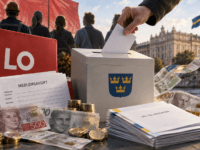






Sweden likes to think of its elections as comparatively clean affairs, far removed from the billion-dollar campaign machines associated with American politics.
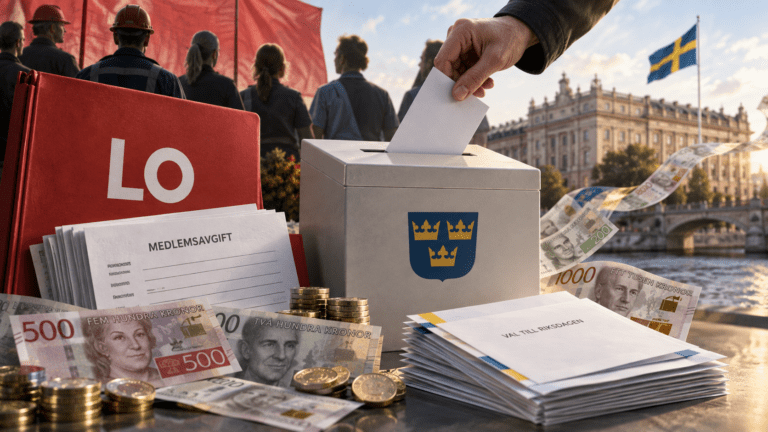
But the 2026 election raises an uncomfortable question about the relationship between organized labour and party politics: how much political influence should a trade union be able to purchase with money ultimately supplied, at least in part, by its members?
At the centre of the debate is Landsorganisationen i Sverige, better known as LO, Sweden’s largest trade union confederation.
LO did not hide its political ambitions in the 2026 election. Quite the opposite.
Its own election strategy explicitly stated several goals, including achieving a Social Democratic-led government, increasing the share of LO members voting for the Social Democrats, electing more LO-affiliated candidates and increasing the impact of LO’s political positions. The organisation also set a target of conducting 500,000 conversations with members during the campaign. (LänsOss)
That is considerably more than simply encouraging union members to vote.
It is an organised political campaign designed to produce a particular political outcome.
LO Put Tens of Millions Into the Election
According to trade-union newspaper Arbetet, LO centrally allocated around SEK 30 million to its own 2026 election campaign, while simultaneously providing approximately SEK 6 million directly to the Social Democratic Party. (Arbetet)
LO’s own political advertising disclosures provide another glimpse into the scale of the operation.
One central LO political advertising campaign running from March 1 until election day on September 13 was reported to cost SEK 12.8 million excluding VAT. LO stated that the campaign was financed through its election budget using its “own funds.” (LänsOss)
That was not necessarily the entirety of LO-related political spending.
Regional LO organisations ran their own operations. LO’s Stockholm district, for example, disclosed a political advertising campaign costing SEK 1 million, while LO districts spent almost SEK 965,000 on 46,500 politically themed “fika boxes.” (LänsOss)
Individual unions could conduct campaigns of their own as well.
It is therefore important not to simply add every disclosed figure together, since some spending may fall within broader budgets. But the publicly available information makes one thing clear: organized labour committed significant financial and organisational resources to influencing the 2026 election.
And Some of the Money Really Does Come From Members
This is where the controversy becomes more difficult for LO.
LO is financed partly through payments from its member unions. Its 2025 annual report records SEK 245.1 million in membership-fee income, with member unions paying LO roughly SEK 203 to SEK 225 annually for each member. LO also has other income and substantial financial assets, meaning it would be inaccurate to claim that every krona spent on the 2026 campaign can be traced directly to an individual worker’s monthly union payment. (LänsOss)
The direct support to the Social Democrats is clearer.
SVT reported that LO’s approximately SEK 6 million annual contribution to the Social Democrats comes from membership fees, amounting to a little over four kronor per member per year. LO chairman Johan Lindholm acknowledged in 2024 that members were frustrated by the arrangement and described the system as potentially outdated. (SVT Nyheter)
A Swedish government inquiry published in 2025 likewise described LO’s annual SEK 6 million financial contribution to the Social Democrats, equivalent to roughly four kronor per member annually. (Regeringskansliet)
And despite the earlier discussion about reconsidering that relationship, LO’s central SEK 6 million contribution remained in place for the 2026 election. (Arbetet)
The Problem: LO Members Don’t All Vote Social Democrat
This is perhaps the most politically sensitive part of the arrangement.
Being an LO-affiliated worker does not automatically mean being a Social Democrat.
SVT reported in 2024 that around six out of ten LO members voted for parties other than the Social Democrats. (SVT Nyheter)
Yet money collected through the broader union structure continued to support one particular political party.
That creates an obvious tension.
LO can argue that political activity is part of its democratic mandate. Decisions are made through its congress and elected organisational structures, and the organisation maintains that political decisions regarding pensions, unemployment insurance, labour law and working conditions directly affect its members.
There is a legitimate argument there. Trade unions have every reason to participate in political debate about policies affecting workers.
But critics can reasonably ask whether lobbying politicians on labour issues is the same thing as financially supporting one political party and running an election campaign whose declared goal is putting that party into government.
Those are not quite the same activity.
Even LO’s Own Unions Are Moving Away From Direct Party Funding
Interestingly, the financial relationship between organized labour and the Social Democrats has actually been weakening.
Arbetet reported before the election that only two of LO’s 13 affiliated unions, GS and IF Metall, were still providing direct financial contributions to the Social Democrats in 2026.
A decade earlier, considerably more unions participated in direct party financing.
Many unions instead chose to run their own political campaigns. (Arbetet)
That distinction matters.
A union campaigning for abolishing the qualifying-day deduction, improving pensions or strengthening collective bargaining is advocating policies.
Giving money directly to the Social Democratic Party is financing a political organisation.
LO did both.
But Did LO Actually “Buy” the Election?
Here the rhetoric needs to meet the evidence.
There is clear evidence that LO spent substantial amounts attempting to influence the election and openly sought a Social Democratic-led government.
There is clear evidence that LO provided millions directly to the Social Democrats.
There is also evidence that at least some of that direct financial support ultimately came through membership fees.
What there is not evidence for is that LO literally purchased the election result.
Political advertising, campaigning and voter mobilisation can influence elections, but establishing that a particular organisation caused enough voters to change their ballots to determine an election would require evidence that does not currently exist.
The distinction is especially important because, as of September 17, Sweden’s final 2026 parliamentary election result has not yet been formally established. Valmyndigheten says the final result is expected during the weekend following the September 13 election. (Valcentralen)
The preliminary count has shown an extremely close contest. With roughly 95 percent of votes counted earlier in the process, the opposition stood at approximately 49.6 percent against 49.0 percent for the Tidö parties, corresponding at that stage to 176 versus 173 seats. (Omni)
In an election that close, every major campaign organisation will naturally claim significance.
That still does not prove causation.
The Bigger Question Is About Consent
Perhaps the more important controversy is therefore not whether LO “bought” the 2026 election.
It is whether a worker joining a union to gain representation over wages, working conditions and employment rights should automatically help finance political campaigning for a party that worker may actively oppose.
LO’s leadership can point to congress decisions and representative democracy within the union movement.
Critics can point to the millions of members whose individual political preferences may differ dramatically from those institutional decisions.
Both facts can exist simultaneously.
Trade unions have every right to participate in Sweden’s political debate. Workers organising collectively to influence legislation is itself an important part of democracy.
But when that political activity includes millions of kronor in party contributions, multimillion-krona advertising campaigns, extensive voter mobilisation and an explicit organisational objective of installing a particular party in government, scrutiny is equally legitimate.
The remarkable thing about LO’s 2026 campaign is therefore not a secret plot to purchase an election.
Much of it was completely public.
LO published its objectives. It disclosed advertising expenditure. It openly supported a Social Democratic-led government. And it continued providing millions of kronor to the Social Democrats.
The democratic question Sweden now faces is simpler and much harder:
Where should the line be drawn between representing workers politically and using workers’ collective financial power to campaign for a political party?



Swedish unions are known for using their members money on anything but their members.
Exactly
I don’t think anyone is surprised in Sweden. Not even their own members.
LO is infamous for interfering in Swedish elections
🤣 Of course they did. Every election!
Not even their own members are surprised by this.
Varför blir man inte förvånad?!