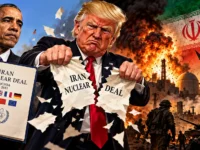




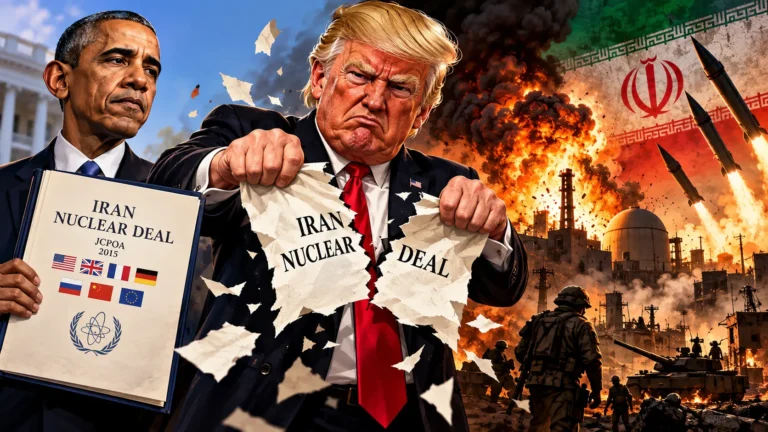

In 2015, the United States and other world powers reached an agreement designed to put strict limits on Iran’s nuclear program and keep it from developing a nuclear weapon.
In 2018, President Donald Trump pulled the United States out of that agreement.
He promised something better.
Eight years later, the United States was at war with Iran, and Washington was once again trying to negotiate restrictions on the same Iranian nuclear program.
That sequence does not mean Trump alone caused everything that followed. Iran made its own decisions, expanded its nuclear activities, supported armed groups across the Middle East, developed ballistic missiles, and repeatedly clashed with the United States and its allies.
But the history raises an unavoidable question: Did abandoning an imperfect but functioning nuclear agreement ultimately leave the United States facing a more dangerous Iranian nuclear program and fewer diplomatic options?
What the Iran nuclear deal actually did
The 2015 agreement was formally known as the Joint Comprehensive Plan of Action, or JCPOA.
It was negotiated between Iran and the P5+1: the United States, United Kingdom, France, Germany, Russia and China, together with the European Union.
Under the agreement, Iran accepted major restrictions on its nuclear activities in exchange for sanctions relief.
The JCPOA limited Iran’s uranium enrichment, restricted its stockpile of enriched uranium, placed limits on centrifuges and nuclear facilities, and subjected the program to extensive monitoring by the International Atomic Energy Agency.
It was not a permanent solution to every problem involving Iran.
The agreement did not eliminate Iran’s ballistic missile program. It did not stop Tehran from supporting armed groups and proxies around the Middle East. Some of its nuclear restrictions also contained expiration dates, which became one of the strongest arguments made by its critics.
Trump repeatedly attacked those weaknesses.
But there is an important fact that tends to disappear when discussing what happened next.
Iran was implementing its nuclear-related JCPOA commitments when Trump decided to withdraw.
In March 2018, only two months before Trump’s withdrawal, IAEA Director General Yukiya Amano told the agency’s Board of Governors that Iran was implementing its nuclear-related commitments under the agreement.
The deal may have been imperfect, but its nuclear restrictions were operating.
Trump wanted something different
Trump had attacked the JCPOA long before becoming president.
His administration argued that the agreement gave Iran too much sanctions relief, allowed important restrictions eventually to expire, failed to adequately address ballistic missiles, and did nothing to constrain Iran’s wider activities across the Middle East.
In January 2018, Trump demanded that the agreement effectively be strengthened. He wanted tougher inspection provisions, permanent restrictions preventing Iran from approaching a nuclear weapon, and measures connecting Iran’s missile program to nuclear sanctions.
When those changes did not materialize, Trump acted.
On May 8, 2018, he announced that the United States was leaving the JCPOA and restoring sanctions against Iran.
Trump explicitly said his administration would work with allies to find what he called a “real, comprehensive, and lasting solution” addressing Iran’s nuclear program, missiles, terrorism and regional activities.
In other words, the administration was not merely abandoning the existing agreement.
It believed pressure could produce a broader one.
Maximum pressure replaced the nuclear deal
The administration subsequently pursued its “maximum pressure” strategy.
Sanctions were restored and expanded with the goal of putting enormous economic pressure on Tehran.
Iran initially remained within important JCPOA limits after the American withdrawal, but the agreement gradually unraveled.
Eventually, Iran began exceeding its restrictions and dramatically expanding its nuclear activities.
By November 2024, the IAEA reported that Iran was producing and accumulating uranium enriched to 60 percent U-235. The agency also said years without JCPOA monitoring had caused it to lose continuity of knowledge regarding important parts of Iran’s nuclear program.
That is one of the central ironies of the story.
The agreement Trump withdrew from had imposed restrictions on Iran’s enrichment program and provided an extensive international monitoring system.
Years later, Iran possessed a much larger and more advanced nuclear program.
And America eventually returned to negotiations
Trump returned to the White House in January 2025 still promising that Iran would never obtain a nuclear weapon.
But despite the years of maximum pressure, the fundamental problem remained.
Washington again turned to negotiations.
By February 2026, the Trump administration and Iran were holding indirect nuclear negotiations mediated by Oman.
Iran reportedly offered concessions, including reducing its stockpile of highly enriched uranium, while demanding sanctions relief and recognition of a right to peaceful uranium enrichment.
The negotiations did not produce an agreement.
On February 27, after another round of talks ended without a deal, Trump publicly expressed frustration and warned that military force might be necessary.
The following day, the United States and Israel launched strikes against Iran.
From negotiations to war
The military campaign became Operation Epic Fury.
The Trump administration said its objectives included destroying Iran’s ballistic missile capabilities and navy, weakening its regional proxy network and ensuring that Iran could never obtain a nuclear weapon.
The conflict subsequently expanded far beyond a limited strike on nuclear facilities.
Shipping through the Strait of Hormuz was severely disrupted. Fighting spread across the region. Global oil supplies were affected. Thousands of people were killed during the conflict, according to reporting by Reuters as the war continued into September 2026.
And then something remarkable happened.
The United States and Iran went back to negotiating.
Again.
Back where the story started
In June 2026, Washington and Tehran signed an interim agreement intended to extend a ceasefire and create time to negotiate a permanent settlement.
And what was one of the major unresolved issues?
Iran’s nuclear program.
Reuters reported that the agreement stated Iran would not have a nuclear weapon, while the future of the country’s nuclear program was left for subsequent negotiations.
By September, American and Iranian officials were once again communicating through mediators about ending the war, sanctions relief, inspections and nuclear restrictions.
The United States had traveled an extraordinary geopolitical circle.
There was a negotiated nuclear agreement.
Trump withdrew from it.
The United States imposed maximum economic pressure.
Iran expanded its nuclear program.
Diplomacy resumed.
Diplomacy failed.
War followed.
And after months of fighting, diplomacy resumed once again.
Was the original deal perfect? No.
Any serious examination of the JCPOA also has to acknowledge why it was controversial.
It did not permanently eliminate Iran’s ability to enrich uranium. Some restrictions were temporary. It did not solve the ballistic missile problem. It did not end Iran’s support for armed groups such as Hezbollah, nor did it settle the broader conflict between Iran, Israel and the United States.
Trump’s objections to those limitations were real policy disagreements, not invented problems.
It is also impossible to know the counterfactual with certainty. Nobody can prove what Iran, Israel or the United States would have done had Washington remained in the JCPOA.
Iran itself bears responsibility for decisions it made after 2018, including expanding enrichment and restricting international monitoring. The Iranian government was not a passive participant in the escalation.
But none of that changes the chronology.
When Trump withdrew from the agreement in 2018, international inspectors said Iran was implementing its nuclear commitments.
Trump believed he could obtain something better.
Instead, the original framework collapsed, Iran’s nuclear capabilities expanded dramatically, negotiations repeatedly failed, and the United States eventually entered a direct war with Iran.
Now, in September 2026, Washington and Tehran are once again searching for a negotiated settlement involving nuclear restrictions, inspections and sanctions.
The argument over the JCPOA was always about whether accepting an imperfect agreement was preferable to gambling on pressure producing a better one.
Eight years after Trump chose the gamble, the United States is still trying to negotiate an answer to the same nuclear problem.
Only now it is doing so after sanctions, escalation, military strikes and months of war.