







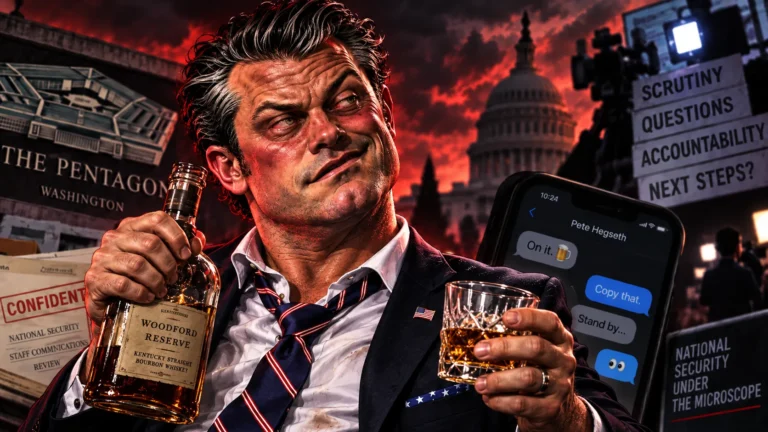

Pete Hegseth’s rise to one of the most powerful positions in the United States government was unusual even by Washington standards.
Before becoming Secretary of Defense in January 2025, Hegseth was best known to millions of Americans as a Fox News television personality. He was also an Army National Guard veteran who served in Iraq and Afghanistan, earned two Bronze Star Medals, led veterans’ advocacy organizations and wrote several books arguing that the U.S. military had become too politically correct and bureaucratic.
What he did not have was extensive experience managing anything remotely comparable to the Pentagon.
During his confirmation process, Hegseth acknowledged that the largest organization he had previously managed consisted of roughly 100 people, with a budget of about $16 million. As defense secretary, he suddenly became responsible for an institution employing roughly 1.3 million active-duty service members and nearly one million civilian workers, with a budget approaching $1 trillion.
That gap between experience and responsibility was one of the reasons his confirmation became so contentious.
A confirmation decided by a single vote
Hegseth was confirmed on January 24, 2025, after the Senate split 50-50. Vice President JD Vance had to cast the tie-breaking vote.
Three Republican senators, Lisa Murkowski, Susan Collins and Mitch McConnell, joined Democrats and independents in opposing him. McConnell specifically questioned whether Hegseth had demonstrated the ability to manage an institution as vast and complicated as the Pentagon.
It was only the second time in U.S. history that a vice president had been required to break a tie over a Cabinet nomination.
Hegseth entered office promising to restore what he called a “warrior ethos,” eliminate diversity, equity and inclusion programs and dramatically change the Pentagon’s culture.
Those promises were attractive to supporters who believed the military had become distracted by political and social issues.
But Hegseth’s critics feared that the Pentagon was being handed to someone whose political instincts were stronger than his management experience.
Events that followed gave those concerns considerably more fuel.
The Signal scandal
The most serious documented controversy of Hegseth’s tenure involved the messaging application Signal.
In March 2025, senior Trump administration officials used a Signal group chat to discuss an impending U.S. military operation against Houthi forces in Yemen. The Atlantic editor Jeffrey Goldberg was accidentally added to the conversation.
Hegseth sent information concerning the upcoming strikes, including operational details about aircraft, weapons and timing shortly before the attack began. Administration officials maintained that classified information had not been transmitted, while critics argued that operational information of that sensitivity should never have been shared on an ordinary commercial messaging application.
The controversy did not end with political arguments.
A Pentagon inspector general investigation later concluded that Hegseth had violated Defense Department policy by conducting official business through his personal device and Signal.
More importantly, the inspector general found that the information Hegseth shared created an operational-security risk that could potentially have endangered American pilots or jeopardized the mission.
The watchdog also found that Hegseth possessed the authority to determine that the information did not require classification. The report therefore did not conclude that he had improperly disclosed classified material.
That distinction matters.
But so does the inspector general’s central finding: the defense secretary used an unauthorized platform and personal device to transmit sensitive information concerning an imminent military operation, creating unnecessary risk to U.S. personnel.
For someone running an organization that demands extraordinary information-security discipline from millions of employees, it was a damaging episode.
A Pentagon increasingly hostile to the press
Hegseth has also imposed increasingly restrictive rules on journalists covering the Pentagon.
Reporters were barred from freely accessing areas that had traditionally been open to credentialed Pentagon journalists and were increasingly required to be escorted.
Later rules went considerably further.
Major news organizations including Fox News, Hegseth’s former employer, rejected new Pentagon credentialing requirements that they argued could restrict journalists from independently gathering and reporting information.
ABC, CBS, NBC, CNN, The New York Times, The Associated Press and other organizations also refused to accept the rules.
Hegseth argued that tighter controls were necessary to prevent leaks and protect sensitive information.
Journalists and press-freedom organizations countered that the policies interfered with independent reporting and reduced transparency at an institution responsible for enormous amounts of taxpayer money and military power.
Whatever one thinks of the media, the Pentagon is not an ordinary government department. Decisions made behind its walls can lead directly to war, casualties and hundreds of billions of dollars in spending.
That makes independent scrutiny particularly important.
Firing senior military leaders
Hegseth has also overseen an unusually aggressive turnover among senior military leadership.
Among those removed during his tenure was Army Chief of Staff General Randy George, who was abruptly dismissed in April 2026 while the United States was engaged in active military operations in the Middle East.
No detailed public explanation for George’s dismissal was initially provided. Other senior Army officers were removed at the same time.
The dismissals followed earlier removals of senior military leaders, including General C.Q. Brown.
Presidents and defense secretaries absolutely possess the authority to replace military leadership. Civilian control of the armed forces is one of the foundations of the American system.
But critics have questioned whether repeated removals without detailed explanations risk politicizing senior military command or weakening institutional continuity.
Supporters of Hegseth take the opposite view: that changing entrenched leadership is necessary if the Pentagon is genuinely going to be reformed.
The disagreement reflects a larger question surrounding his leadership.
Is Hegseth dismantling a stagnant bureaucracy?
Or destabilizing institutions that depend heavily on experience and continuity?
Women in combat
Hegseth’s views about women serving in combat roles also followed him into the Pentagon.
Before becoming defense secretary, he repeatedly expressed opposition to women serving in ground combat positions.
During his confirmation process, however, his position softened substantially as Republican senators questioned him about the issue.
His earlier statements formed part of a broader criticism of what he described as politically motivated changes to military standards.
Supporters argue that Hegseth’s focus on physical standards and combat effectiveness is legitimate and necessary.
Critics argue that blanket assumptions about women ignore the military’s ability to establish demanding, job-specific standards and allow anyone capable of meeting them to serve.
The dispute illustrates something important about Hegseth.
He did not arrive at the Pentagon as an ideologically neutral administrator.
He arrived with a very public agenda for remaking military culture.
The DEI purge
One of Hegseth’s clearest priorities has been eliminating diversity, equity and inclusion programs throughout the military.
Working under executive orders signed by President Trump, Hegseth moved quickly against DEI initiatives and race-conscious policies within military institutions.
Hegseth argues that military promotions and admissions should be based exclusively on merit and that DEI programs create different standards based on race or sex.
Critics respond that military diversity programs were intended partly to address persistent underrepresentation in the officer corps and ensure that the leadership of the armed forces reflects the personnel serving underneath it.
Again, there is a legitimate policy debate here.
The more controversial issue has been the aggressive language surrounding that debate and the broader removal of programs, personnel and policies associated with previous Pentagon leadership.
An increasingly confrontational relationship with NATO
Hegseth has also become a central figure in the Trump administration’s effort to pressure NATO countries into carrying more of the cost of European defense.
That goal itself is hardly new. American presidents of both parties have urged European governments to increase military spending.
Hegseth’s approach has been noticeably sharper.
In 2026, the Pentagon began a major review of U.S. troop deployments in Europe. Hegseth warned that countries unwilling to support American strategic priorities could face consequences as Washington reconsidered where its forces should be stationed.
Reuters reported growing concern among lawmakers from both parties about how Hegseth was handling NATO relations. European governments have simultaneously accelerated efforts to strengthen their own defense industries and reduce dependence on the United States.
Supporters see leverage.
Critics see a dangerous weakening of alliances that have formed the backbone of Western security since the Second World War.
His troubled personal history
Long before Hegseth entered the Pentagon, questions had been raised about his personal conduct.
Some are documented facts. Others remain allegations and should be treated accordingly.
Hegseth has been divorced twice. His previous marriages involved admitted infidelity, and he fathered a child with the woman who later became his third wife while he was still married to his second.
More seriously, a woman accused Hegseth of sexually assaulting her following a Republican women’s conference in Monterey, California, in 2017.
Police investigated.
Hegseth denied sexually assaulting the woman and told investigators that their encounter had been consensual.
Prosecutors ultimately declined to bring charges, concluding that the evidence was insufficient to prove a case beyond a reasonable doubt.
That means the accusation should not be presented as an established fact.
It is equally inaccurate, however, to claim that no accusation or investigation existed.
Both did.
Allegations involving alcohol and management
During Hegseth’s confirmation process, former colleagues and others also raised allegations concerning heavy drinking and his management of veterans’ organizations.
Hegseth denied wrongdoing. He acknowledged making financial mistakes while running veterans’ groups but rejected accusations of misconduct, and he promised senators that he would abstain from alcohol while serving as defense secretary.
Those allegations mattered politically because Hegseth was seeking control of one of the largest and most complicated organizations on Earth.
The question was never merely whether he had made mistakes in his private life.
It was whether his previous management record demonstrated the judgment and discipline required for the Pentagon.
A career built on confrontation
There is a consistent thread running through Pete Hegseth’s career.
At Princeton, he became known as an outspoken conservative activist and publisher of the Princeton Tory. Reuters found that his clashes with feminist and diversity organizations dated back more than two decades.
He later became a veterans’ advocate, television personality and author who argued that America’s military leadership had been weakened by bureaucracy and progressive social policies.
Then he was given the opportunity to put those ideas into practice.
His supporters see precisely what President Trump promised: an outsider smashing through an entrenched Pentagon establishment.
His critics see something very different: a defense secretary whose limited managerial experience, ideological battles, treatment of military institutions and handling of sensitive information have repeatedly created unnecessary controversy.
The biggest problem is no longer his past
Hegseth’s personal history was understandably a major subject during his confirmation.
But after more than a year in office, the stronger arguments about his leadership no longer depend on allegations from years ago.
There is now an official record.
A Pentagon inspector general concluded that his handling of sensitive military information created operational-security risks.
He has introduced sweeping restrictions on Pentagon journalists that major news organizations across the political spectrum rejected.
He has overseen major changes in senior military leadership, military culture, personnel policy and America’s relationships with allies.
And he continues to pursue a vision of the Pentagon built around aggressive institutional disruption.
Whether those changes ultimately strengthen the American military will be judged over years rather than months.
But one conclusion is already difficult to dispute:
Pete Hegseth entered Washington promising to shake up the Pentagon.
He certainly has. And not in a good way.