







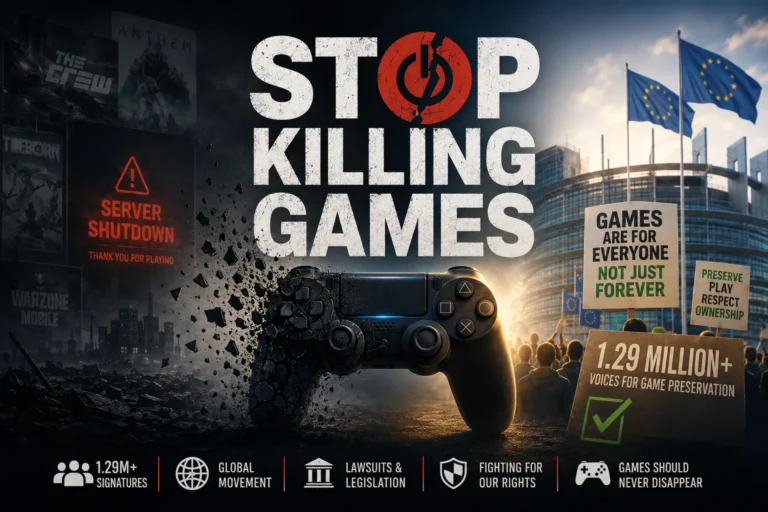

In just a few years, the Stop Killing Games (SKG) movement has evolved from a niche online campaign into one of the most significant consumer rights efforts in modern gaming. What started as frustration over dead live-service titles has turned into a global political and legal battle over what it really means to “own” a video game.
So where does SKG stand today? The answer is complicated: it has never been more influential and never faced bigger obstacles.
From Petition to Political Force
At its core, SKG argues something simple: when you buy a game, it shouldn’t be remotely destroyed by the publisher. The movement gained traction after high-profile shutdowns like The Crew, where purchased games became unplayable overnight.
By early 2026, SKG achieved a major milestone:
- Over 1.29 million verified signatures in the EU citizen initiative
- Formal submission to the European Commission for consideration
This pushed the issue out of forums and into EU-level politics, forcing lawmakers to confront the implications of always-online gaming.
A Major Setback in Europe
Despite that momentum, June 2026 brought a harsh reality check.
The European Commission declined to introduce new laws requiring publishers to keep games playable after shutdowns.
Their reasoning:
- Intellectual property laws make forced preservation complex
- Mandatory support could be disproportionate for companies
- Existing consumer protections were deemed “sufficient”
Instead of legislation, the EU proposed:
- A voluntary industry code of conduct
- Further dialogue between publishers and consumer groups
For many supporters, this felt like a major defeat, especially after over a million signatures. Critics argue it shows regulators are still reluctant to challenge the business models of large publishers.
But the Movement Is Far From Dead
If anything, SKG has adapted rather than collapsed.
1. Institutionalization: NGOs and Long-Term Strategy
SKG is no longer just a petition, it’s now formal organizations in both the EU and US designed for long-term lobbying and legal action.
2. Legislative Momentum Outside the EU
In the United States, the proposed Protect Our Games Act could:
- Require advance notice before shutdowns
- Force publishers to provide offline patches, private servers, or refunds
- Apply to games sold after 2027
This signals a strategic pivot: if Europe won’t act decisively, other jurisdictions might.
3. Legal Action Begins
Consumer groups, backed by SKG, have already taken action:
- A lawsuit against Ubisoft over The Crew shutdown
This could set important precedents about misleading digital ownership claims.
A Growing Problem Fueling the Movement
SKG isn’t operating in a vacuum, the problem is getting worse.
In just the first half of 2026:
- Multiple major games were shut down, including Anthem and Warzone Mobile
- Entire communities lost access to games they paid for
This trend highlights a key issue:
Modern games are increasingly dependent on servers, even for single-player functionality, meaning they can vanish completely.
That reality continues to drive public support for SKG.
Industry Resistance
Game publishers and industry groups remain strongly opposed.
Their main arguments:
- Maintaining or releasing server code is costly
- Security risks from private servers
- Intellectual property concerns
SKG counters that:
- These are business decisions, not technical impossibilities
- Companies could provide end-of-life solutions if required
This clash reflects a deeper tension: games as products vs. games as services.
The Bigger Picture: Ownership in the Digital Age
The SKG debate has expanded beyond gaming.
It now raises fundamental questions:
- Do you own digital purchases, or just license them?
- Should companies be allowed to revoke access after sale?
- Are current consumer protection laws outdated for live-service media?
In many ways, SKG has become a test case for digital ownership rights across all industries.
Conclusion: A Fight Entering Its Next Phase
As of mid-2026, Stop Killing Games sits in a paradoxical position:
 No immediate legislative victory in the EU
 Massive public support and political visibility
- Active legal, legislative, and organizational expansion
The movement didn’t get the law it wanted, but it forced the conversation into the open.
And perhaps that’s the real turning point.
Because even if SKG hasn’t “won” yet, one thing is clear:
The idea that games can simply disappear after purchase is no longer going unchallenged.